Popular fittings › 100 mm blast gate
100 mm blast gate
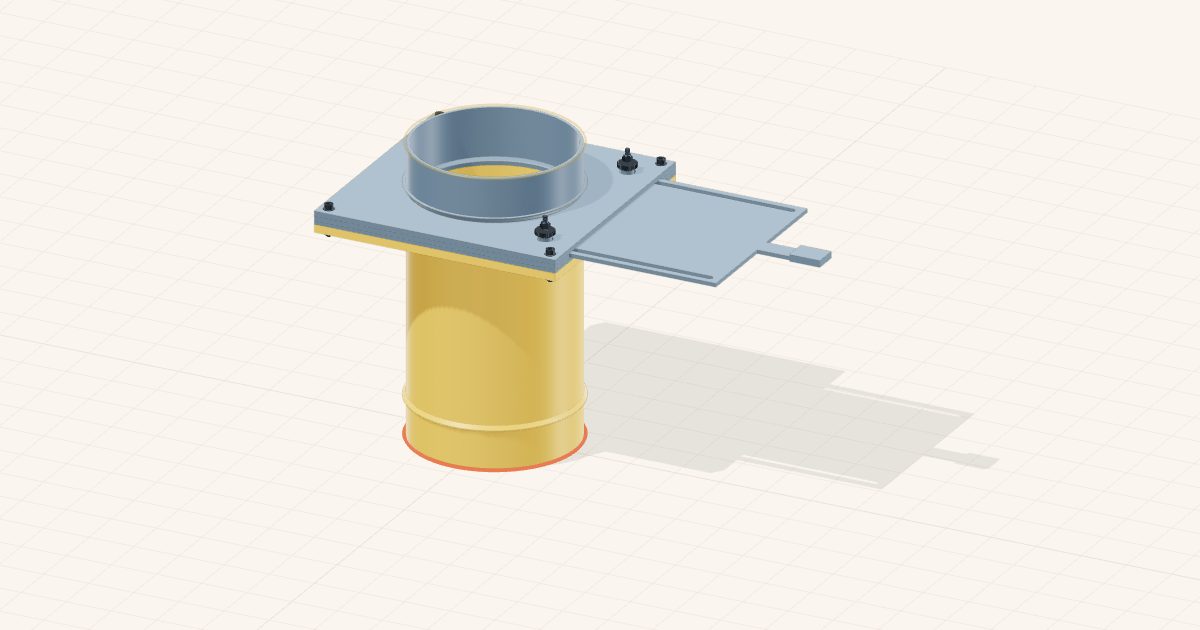
A 3D printable 100 mm sliding blast gate: housing and separate blade, held with standard bolts. Export 3MF, STL or STEP.
 Open in the designer →
Opens with the sizes below. Change anything, then export 3MF, STL or STEP. Free, no account, runs in your browser.
Starting sizes
| End | Inner size | Connection |
|---|---|---|
| Inlet | 100 mm (3.94 in) | Smooth sleeve |
| Outlet | 100 mm (3.94 in) | Smooth sleeve with sliding blast gate |
Need another size? Every dimension is editable in the designer, in millimetres or inches.
What it is
A housing with a separate sliding blade that opens or closes one duct run. Close the gates on machines you are not using so the collector pulls from the one you are. The blade is retained by real bolts through closed slots, not printed clips.
How to measure
For each end, measure the hose, pipe or port it joins with calipers. If that part slides into the fitting, measure its outside diameter and keep “Measure by: Inner diameter”. If the fitting slides into a hose, measure the hose’s inside diameter and switch to “Outer diameter”. Measure twice across the circle; flexible hose is rarely perfectly round.
Print tips
- The export already places every component in its recommended print orientation. Keep supports off sleeves, sockets and any sliding or tight-fit surface so they stay smooth; if your slicer asks for supports, paint them only where an outside overhang needs them.
- The blade prints flat; keep its sliding faces free of supports and brim so it moves freely.
- The “To buy” list shows the bolts, washers and nuts the gate needs.
Frequently asked questions
- What size should I measure?
- For each end, measure the hose, pipe or port it joins with calipers. If that part slides into the fitting, measure its outside diameter and keep “Measure by: Inner diameter”. If the fitting slides into a hose, measure the hose’s inside diameter and switch to “Outer diameter”. Measure twice across the circle; flexible hose is rarely perfectly round.
- What should I print it in?
- PLA or PETG both work for dust collection at room temperature. Print in PETG or ASA if the air is warm or the part sits in the sun. Use 3–4 perimeters for an airtight wall; infill matters much less than wall count for ducts.
- What hardware do I need to buy?
- At these starting sizes it needs: bolts or screws, nuts, washers. The “To buy” list in the designer gives the exact sizes, lengths and quantities for your dimensions.
- Does it need supports?
- The export already places every component in its recommended print orientation. Keep supports off sleeves, sockets and any sliding or tight-fit surface so they stay smooth; if your slicer asks for supports, paint them only where an outside overhang needs them.
More popular fittings
 4 inch blast gateA 3D printable 4 inch blast gate with a separate sliding blade and bolt-on retainers. Free, adjustable, export 3MF, STL or STEP.
 Sliding blast gateA housing and separate sliding blade, retained with standard bolts. Free 3D printable blast gate for any duct size.
 4 inch end capA 3D printable 4 inch end cap with adjustable bore, depth and fit clearance. Free, export 3MF, STL or STEP.
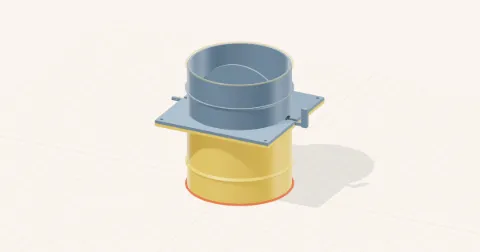 Butterfly damperA separate rotating disc and shaft with a manual handle. Free 3D printable damper for duct and hose.
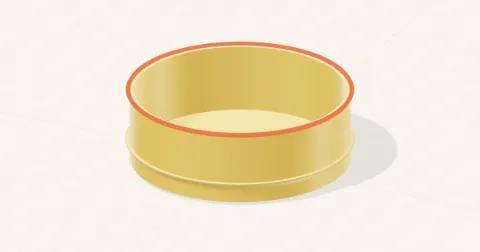 End capA removable cap with configurable bore, depth and end thickness. Free 3D printable, any size.
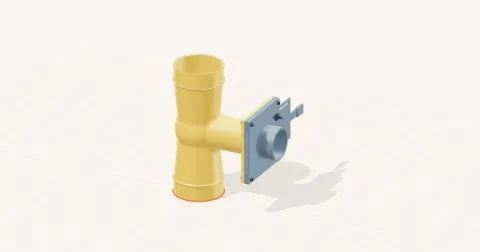 Gated T junctionA through duct with a removable-cover slide gate on its side branch. Free 3D printable.